Send 2,000 emails for free
Try the most intuitive email marketing platform.
 Dec 17, 2025
—
8 min read
Dec 17, 2025
—
8 min read Of all the emails you’ll ever send to your subscribers, the first one is crucial. That’s the email where you thank them for subscribing to your newsletter.
So how do you make it memorable?
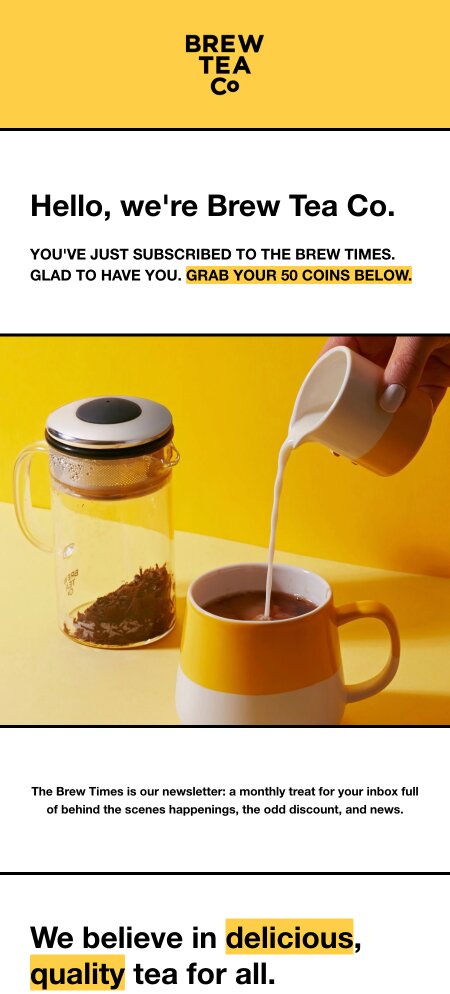
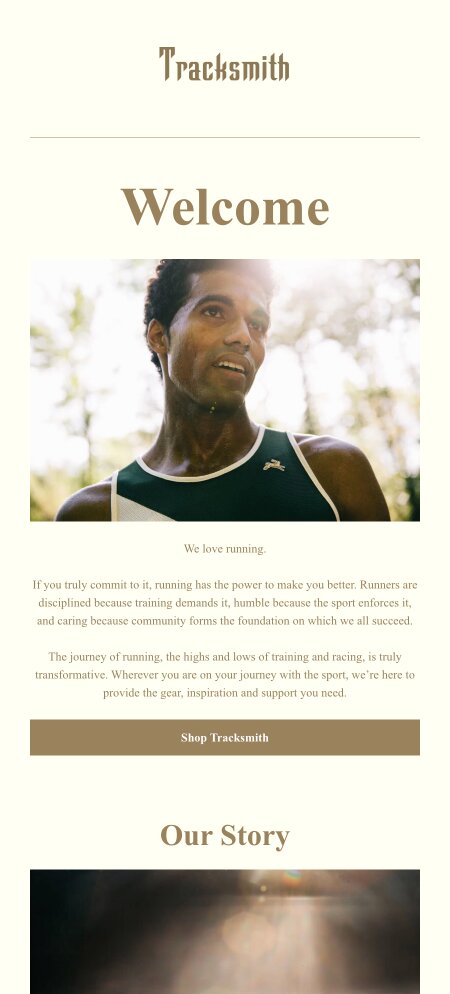
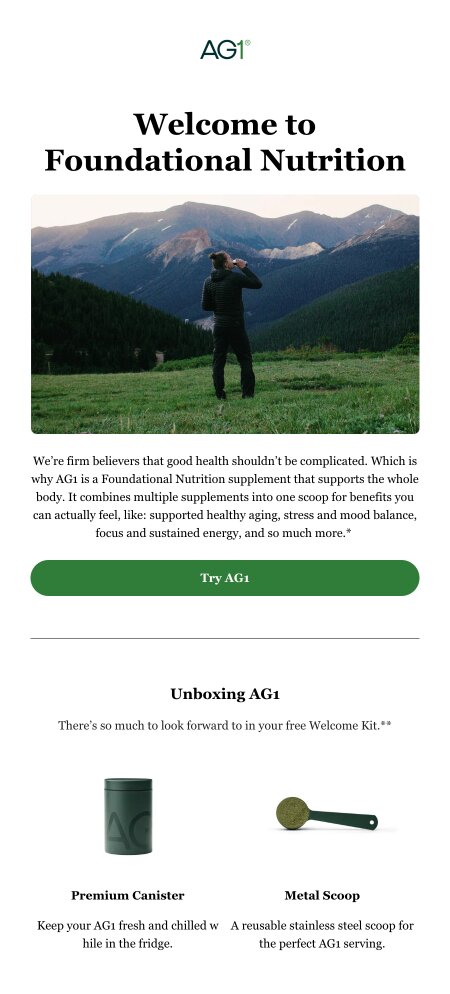
In search of inspiration, I’ve subscribed to 30 different ecommerce brands’ newsletters and sneak-peeked at their welcome emails.
Below, I’ll share 10 of my favorite email examples, explain why they work well, and provide a couple of templates you can steal.
If you’ve ever experienced the blank page paralysis trying to craft an email – any email – you’re not alone. The good news about welcome emails is that most of them fall into one of these 3 categories:
Sometimes it’s a short discount delivery email; other times, it’s a long-form email that has it all: a welcome coupon, a product showcase, and a brand story. The key goal of any welcome email, however, is to bring your new subscriber back to the store.
Let’s see exactly how other brands are doing it.
Before diving into the email content, let’s have a quick look at the subject lines and email previews companies use to welcome new subscribers.
Here are a few examples from my inbox:
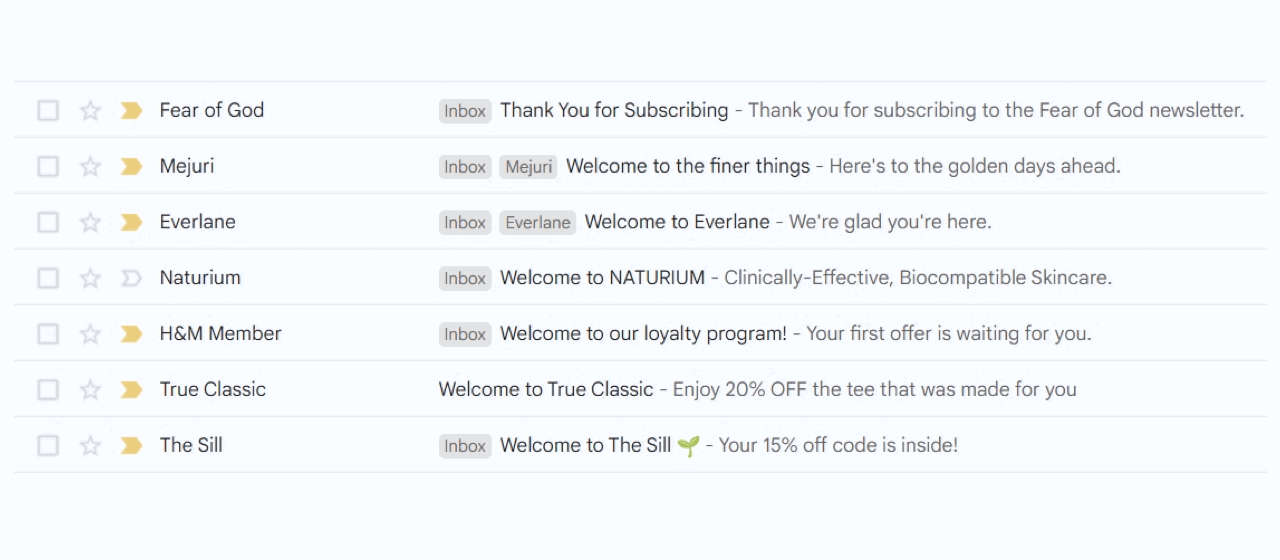
As a newcomer to someone’s inbox, you want to make two things clear: who the email is from and why it’s worth opening. The rest is optional. For example, you can use your subscriber’s first name and insert relevant emoji in the subject or preheader.
Need more ideas? Start by grabbing any of these templates:
Welcome emails average an open rate of 83.63% and a click-through rate of 16.6% — far above typical marketing emails. That makes them the highest-performing message you’ll ever send. So what do successful ecommerce brands include in theirs?
Let’s look at 10 examples.
Since most ecommerce companies grow their email lists using discount incentives, their welcome emails are crafted around discount delivery. But this doesn’t mean you can’t spice things up.
For example, this is how Irregular Sleep Pattern, a bedding and sleepwear brand, welcomes new subscribers.
This short email accomplishes a lot. Not only does it deliver the welcome discount code, but it also shows the product, and introduces the team behind the brand.
Short GIFs work especially well in welcome emails — for example, showing a product in action or a quick brand moment. If you already have a video, you can turn it into an email-ready animation using a free video-to-GIF converter.
Concise copy inviting a reader to go back to the store and use the coupon.
Note how the color palette of the key elements is aligned with branding.
Larger global brands are using a similar approach. For instance, Adidas also delivers a welcome discount code and encourages subscribers to act fast by adding the date when the offer becomes invalid.
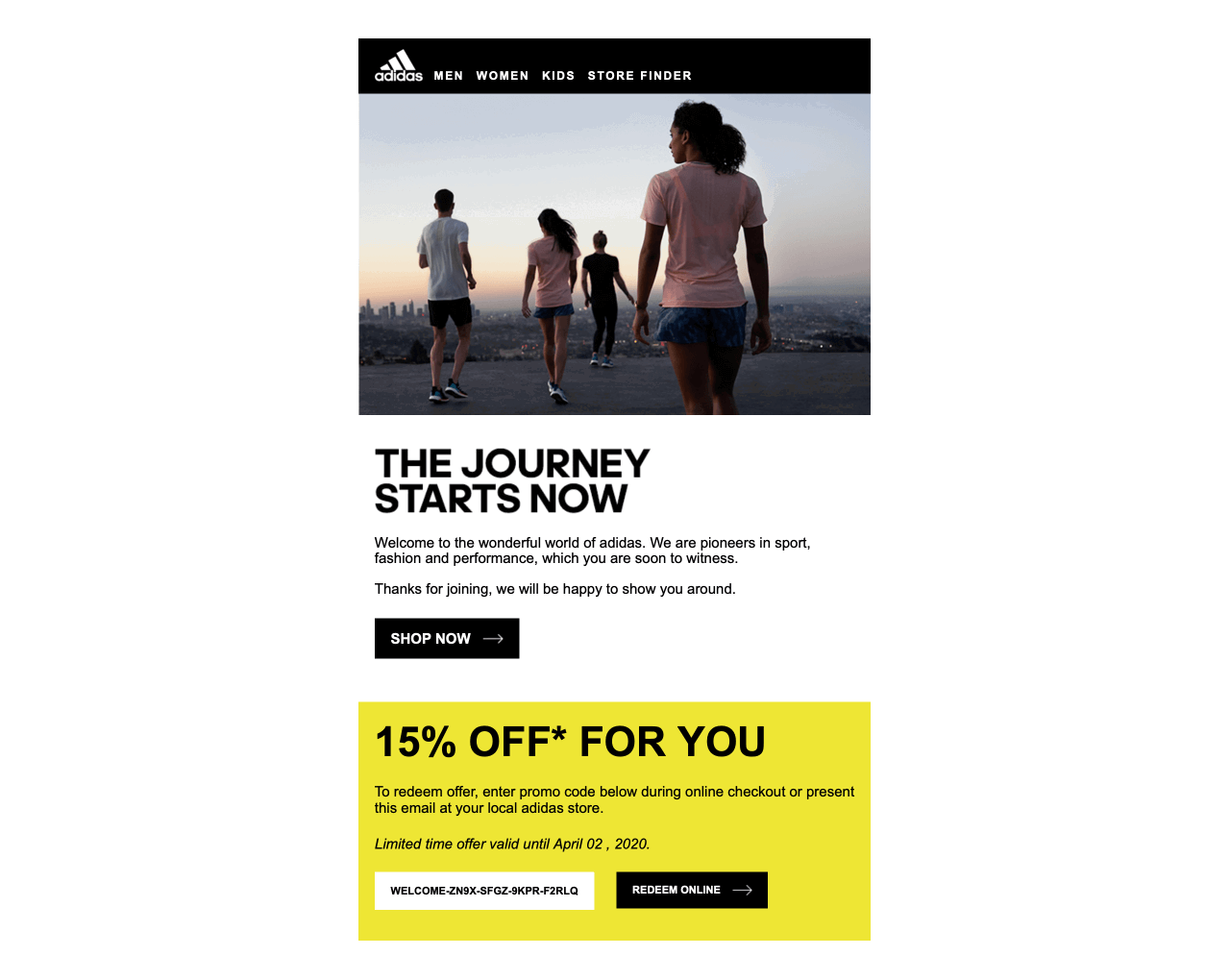
To make the sense of urgency even more apparent, you can add a countdown timer GIF to your email.
If you need to craft a brief welcome discount email, feel free to use the text templates below and tailor them to your needs 👇
Welcome
We’re thrilled to have you here, {{name}}
As a thank you for joining us, here is your 15% discount code:
15OFF
[Visit store now]
You can apply this coupon to any order amount. Just copy the code to the clipboard and paste it at checkout.
Come back soon! It’s a pleasure shopping with you.
{{Brand name}} team
You’ve received this email because you signed up for a {{Brand name}} newsletter
Here is another option for the signup confirmation text — slightly more concise and evoking a sense of urgency.
You’ve unlocked a welcome offer, {{Name}}
We’ll now keep you posted about new collections, sales, and promos.
Next time you visit our store, use your personal discount code to get 15% off your purchase.
15OFF
[Visit store]
Hurry up! The promo expires in 14 days.
{{Brand name}} team
You’ve received this email because you signed up for a {{Brand name}} newsletter
Wondering what else you can include in your welcome email? For visual inspiration, explore these welcome email templates — and for content ideas, keep reading.
Suppose you aren’t offering a discount in exchange for an email. How do you pique the interest of new subscribers then?
One way to do that is by showcasing some of your best items.
Mejuri is an excellent example of a jewelry brand benefiting from email marketing. In their welcome email, they introduce their vision and feature some of the most beautiful pieces.
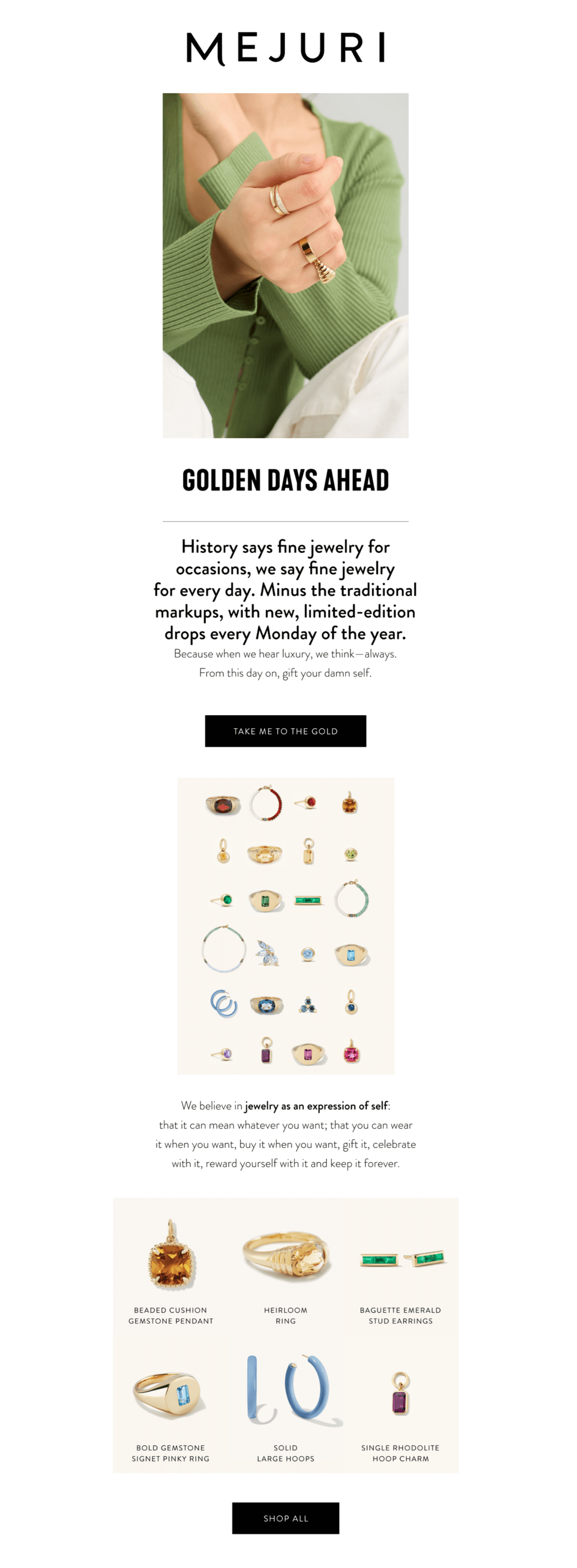
Besides the fact that these visuals are absolute thumb-stoppers for anyone mildly interested in jewelry, the images are also clickable, so the shopping experience starts right in the inbox.
Mejury isn’t afraid of saying things like “gift your damn self” and using their own tone of voice, making the message more memorable.
The email features popular product categories using clickable cards to entice you to explore further.
True Classic, a men’s apparel brand uses a similar approach. However, instead of a gallery, they use a GIF to showcase their most popular T-shirt collection.
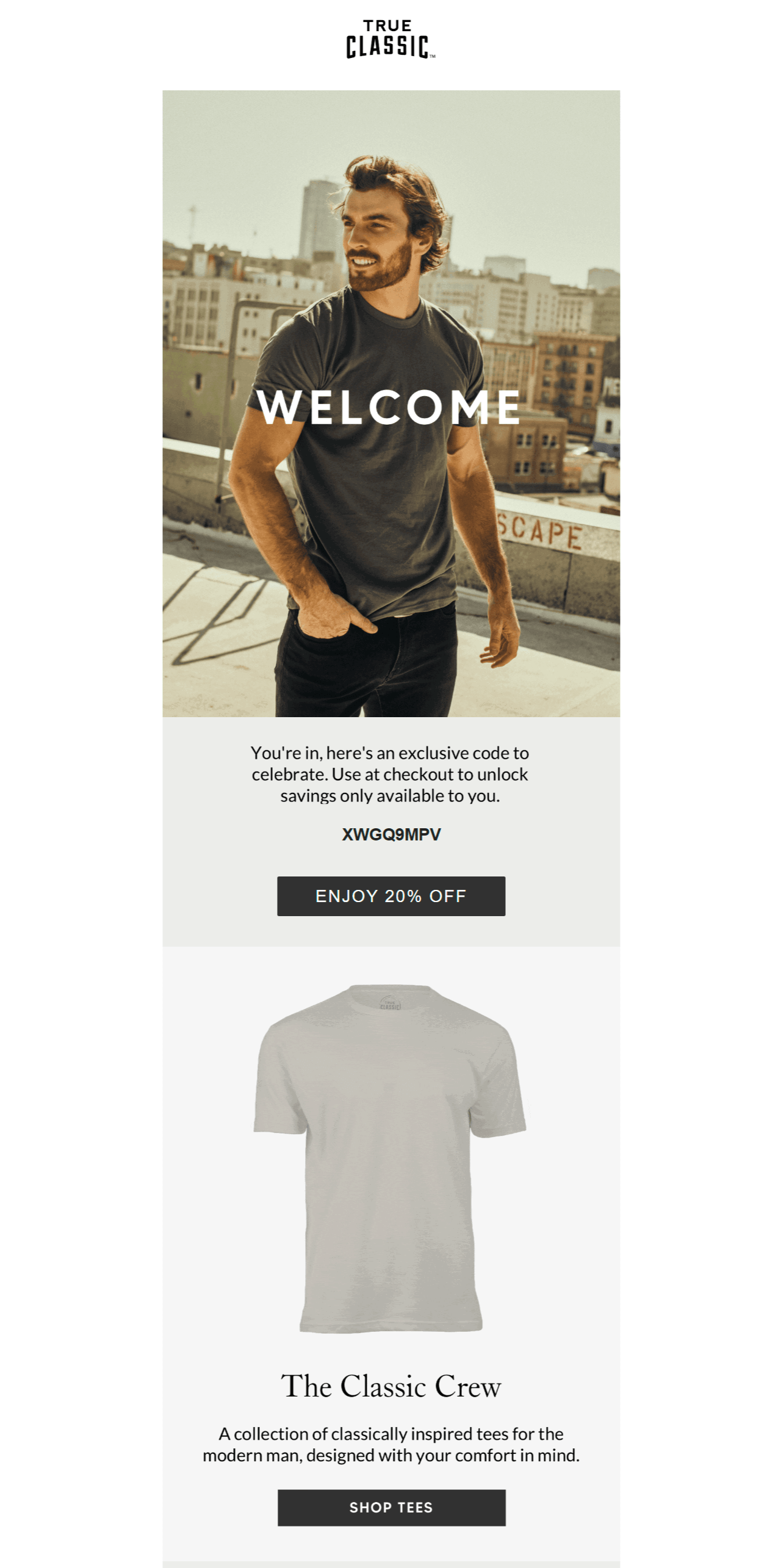
Product image slideshows are an excellent way to showcase bestsellers, demonstrate product features, or evoke the right emotion in your subscribers. Don’t be afraid of using GIFs instead of still images in your emails and see if your engagement rate spikes.
When a new subscriber joins from a product page, they’re not just joining your list — they’re signaling interest. And that gives you a golden opportunity to make your welcome email feel tailored from the start.
Burga, a phone case brand, leans into that moment. Instead of sending a generic “thanks for subscribing” message, they feature the exact product the shopper had just viewed, giving them a reason to come back for it.
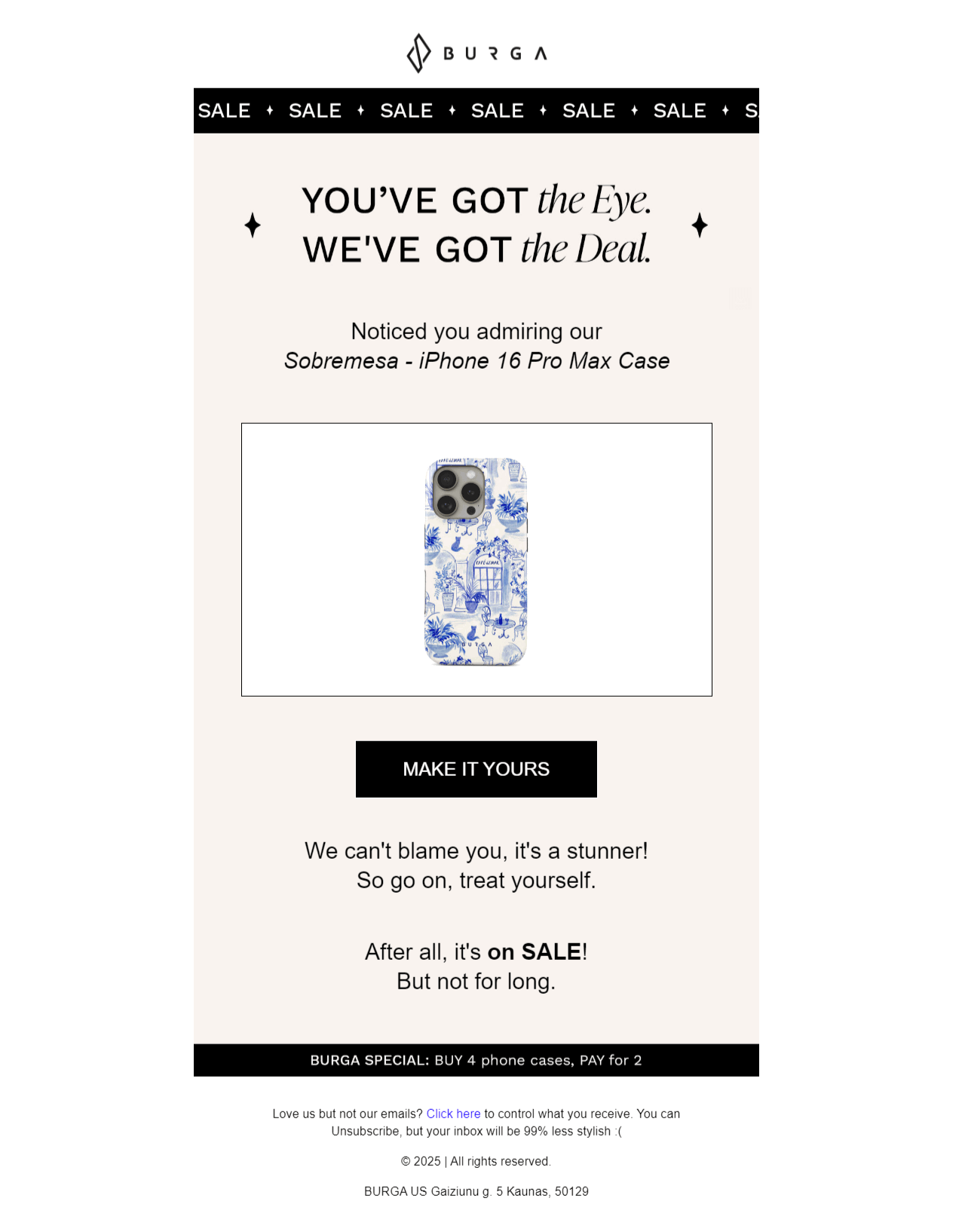
The email spotlights the specific product the subscriber was eyeing, not a random bestseller.
The copy encourages you to act but doesn’t add too much pressure.
One product, one message, one CTA, no distractions.
This type of email is easiest to implement if your store is on Shopify, where most email marketing apps can easily sync browsing or cart data. On other platforms, it may require more custom setup.
Whether the trigger is a product view or an abandoned cart, the takeaway is the same: when a subscriber joins from a product-specific context, follow up with relevance. A well-timed nudge like this can be the difference between a casual visitor and a first-time buyer.
Bestsellers aren’t the only category worth featuring in a welcome email. You can also talk about the seasonal collection, holiday collection, products on sale, or new arrivals.
For instance, Gymshark, a training apparel company, thanked me for subscribing to their newsletter and invited me to explore their latest drops right away.
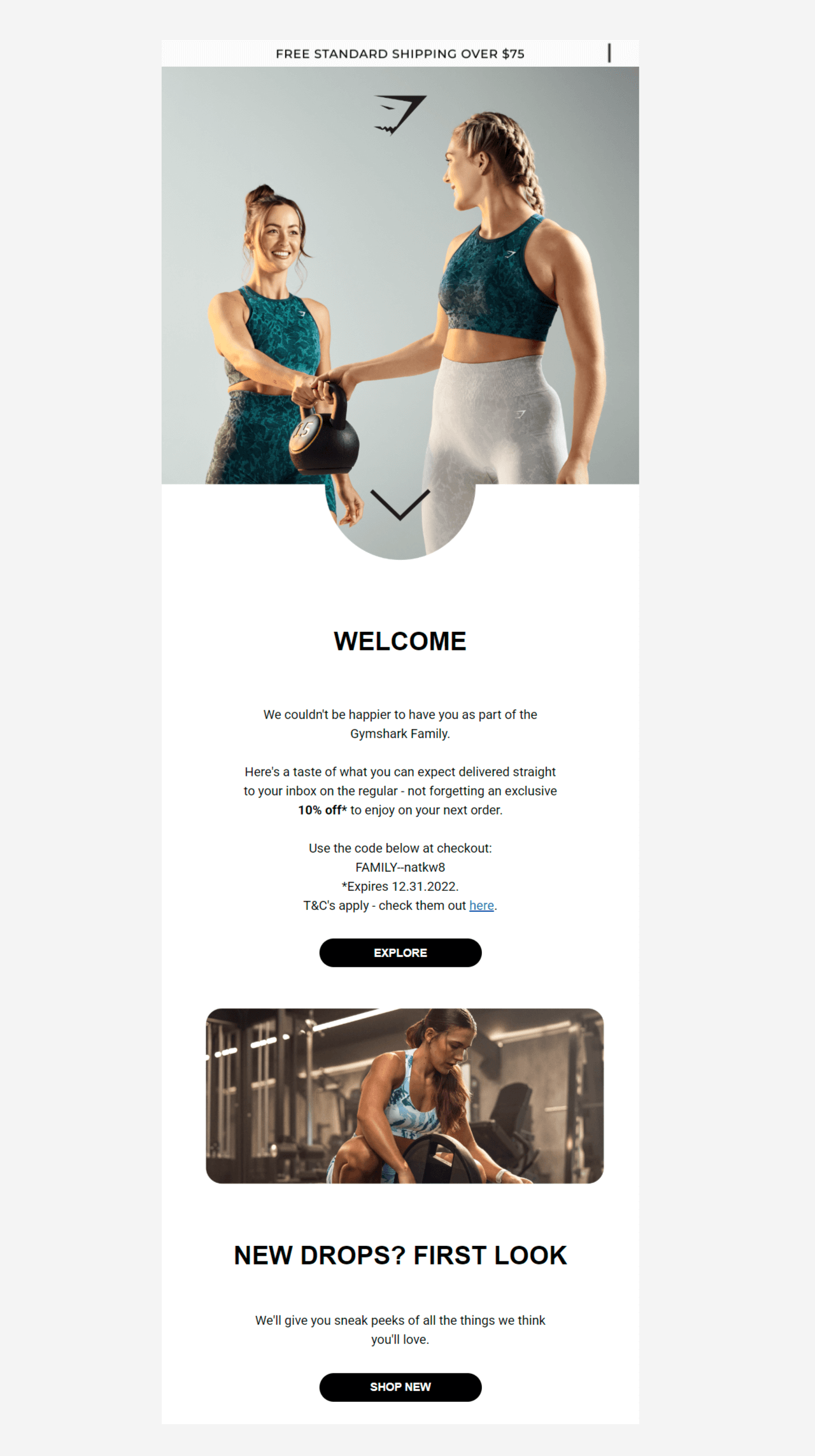
Gymshark does a lot of things well in this email. One of my favorite parts is the way they make you feel special by offering sneak peeks at the new drops and an “inside” look at the sales.
The minimum order requirement for free shipping at the top of the email removes one of the most common buyers’ concerns – the unexpected shipping cost.
Clear code expiration date encourages you to act fast because the offer is time-limited.
The CTA button inviting subscribers to go back to the store and explore new arrivals sets the key action, with no distractions.
Your welcome email is also a great place to share your brand’s unique value proposition (UVP) and show what makes you different.
Everlane, an online clothing store, does an amazing job at explaining how its core values – exceptional quality, ethical production, and transparency – are reflected in the brand, and what it means to customers.
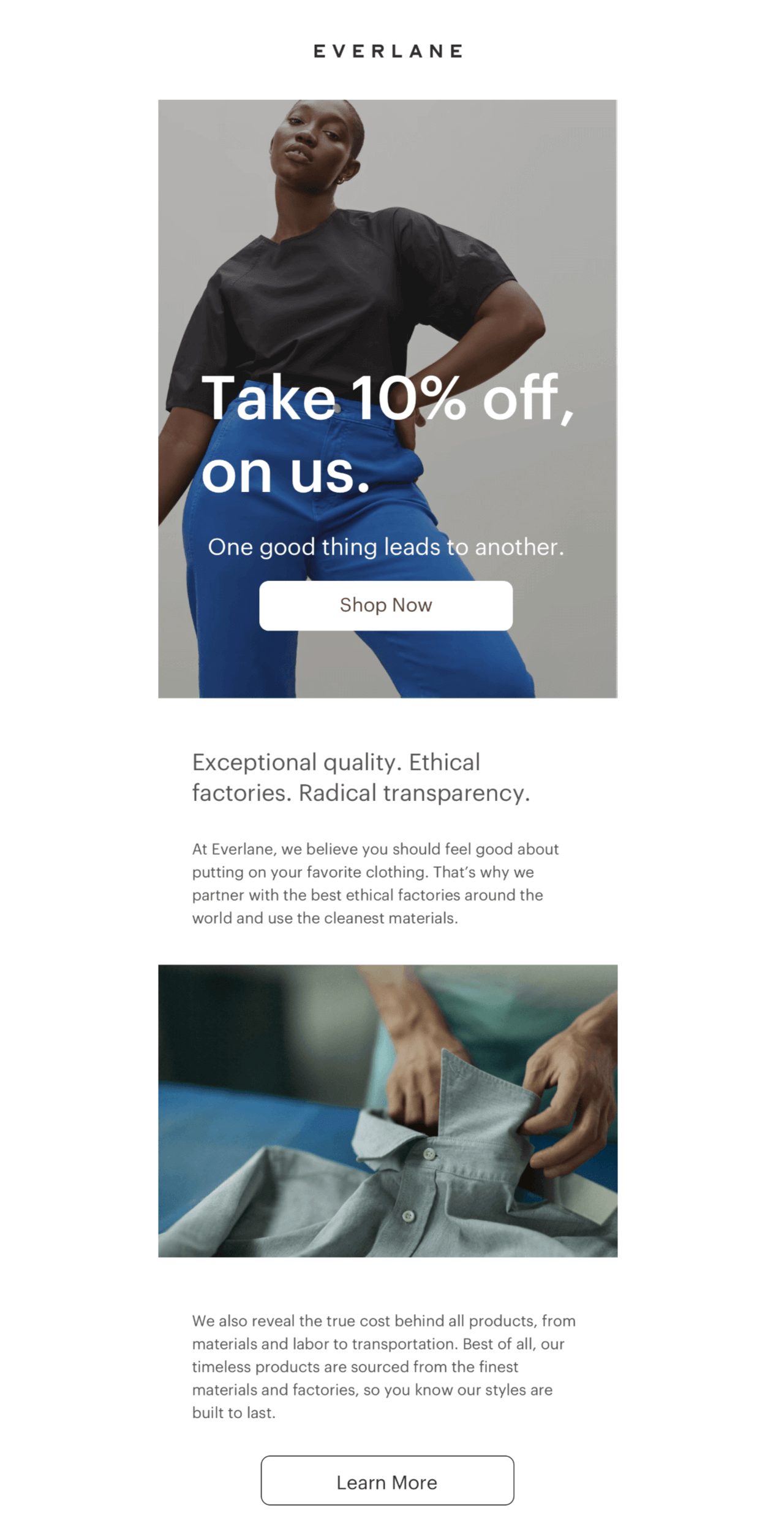
This welcome email shows you that Everlane is not just another fashion brand, but a brand with a clear mission.
Everlane uses the show, don’t tell approach to demonstrate the level of care they have for products and customers.
The thoughtful color choice makes the email look on-brand and visually appealing.
Instead of focusing on the core values, you may want to go the extra mile and share the story behind your brand, talk about the team and product. While it’s not the most common approach, it helps create a deeper level of connection with subscribers.
Here is an example of how Honest Basics, a sustainable clothing brand thanks new email subscribers for joining the newsletter.
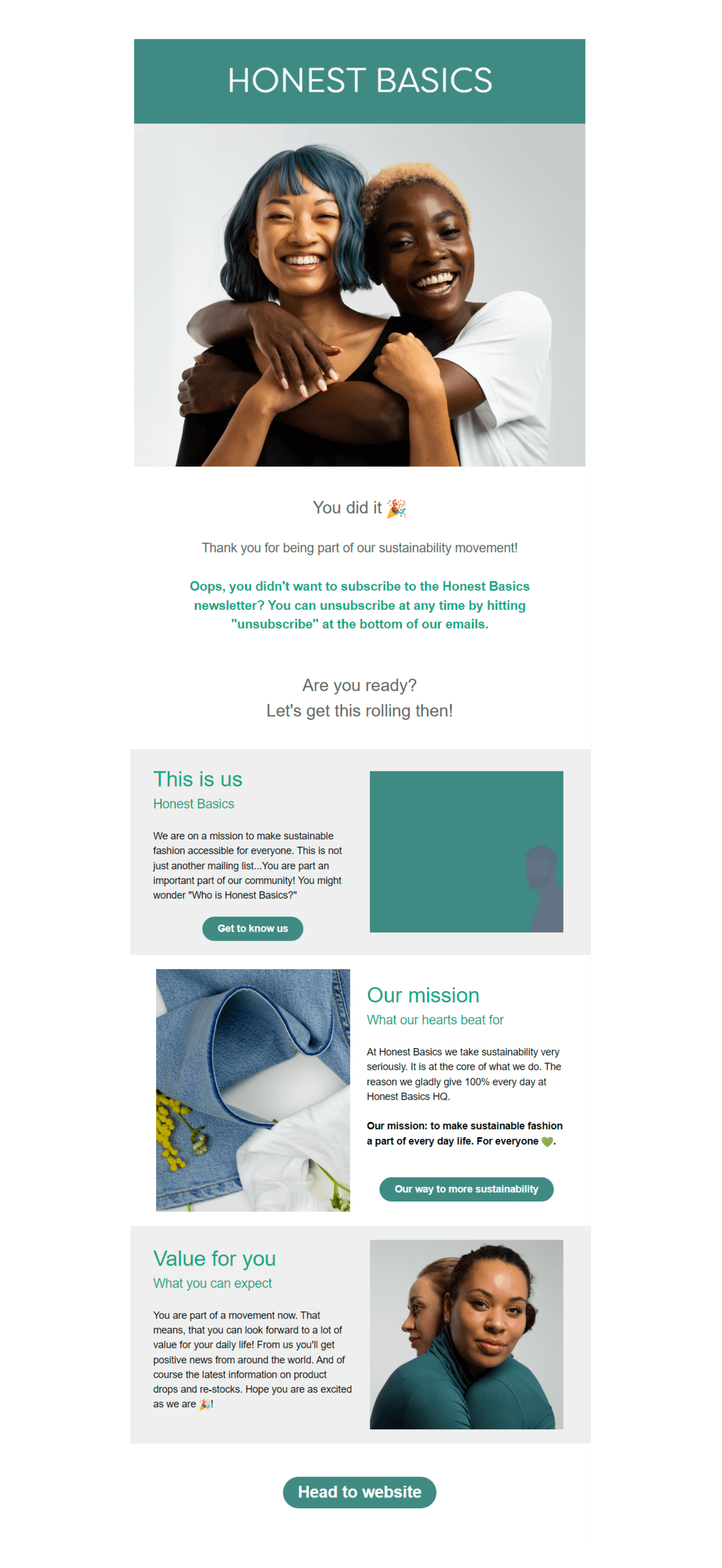
Notice how the photos throughout the email maintain readers’ attention and make the message resonate with its audience. This email is well-structured and it manages to deliver a good deal of information concisely providing the readers with options for the next step.
The “You did it” headline immediately makes subscribers feel good about joining, creating a positive brand association from the first line.
Three distinct sections (“This is us,” “Our mission,” “Value for you”) deliver information in digestible chunks, making it easy to scan.
Warm, genuine images of real people reinforce the brand’s sustainability values and create an emotional connection with subscribers.
Even if your brand is well-known, customer reviews, testimonials, and ratings make an excellent addition to the welcome email sequence. However, if your company is new, using social proof is crucial. No one wants to be the first customer of a new brand, and you want to work with this objection on every step of the funnel including your welcome sequence.
The Sill, a houseplant delivery and plant care brand, recognizes the power of social proof – and uses it in their welcome email.
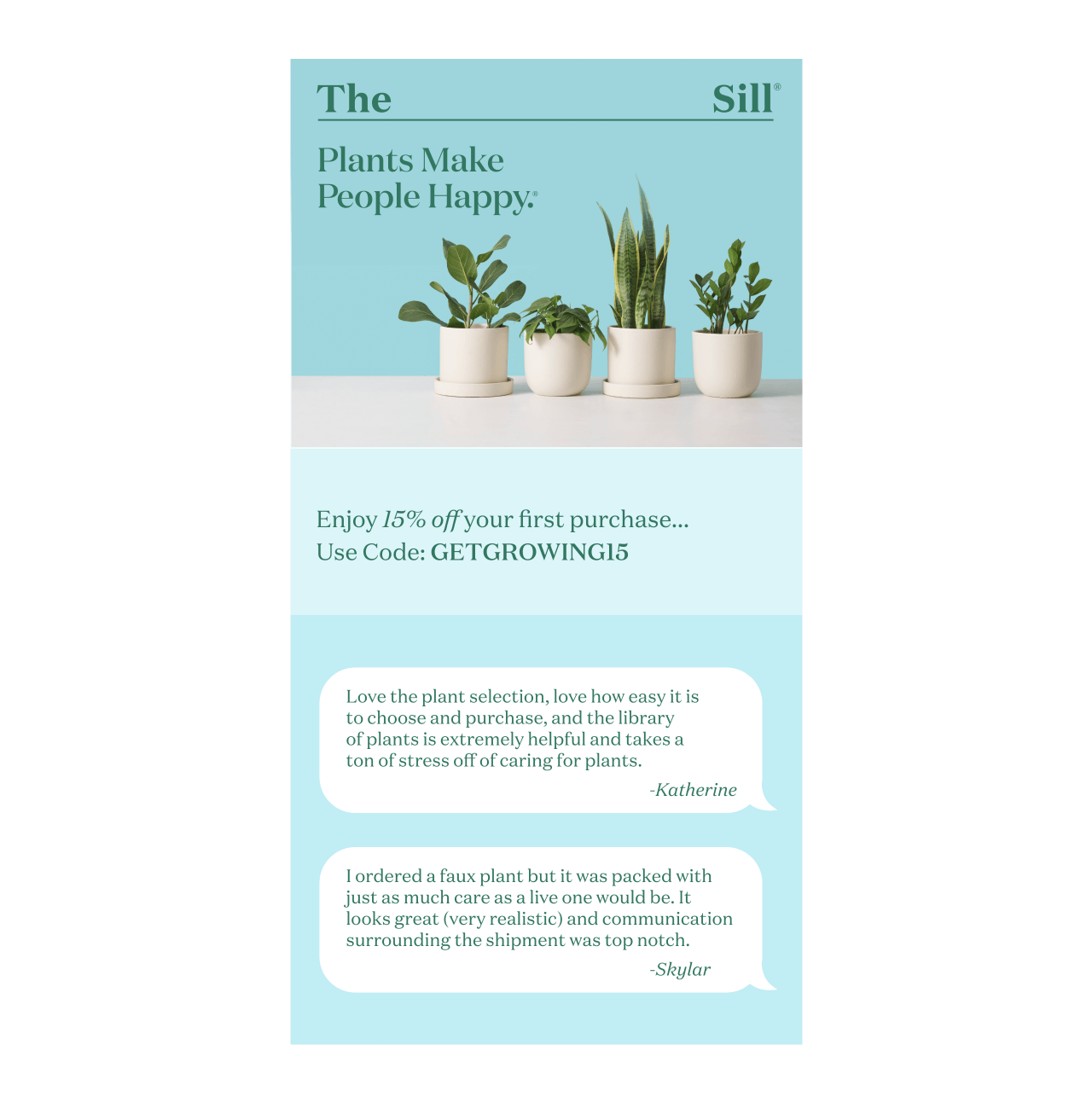
The email opens with the “Plants Make People Happy” motto, and segues into the role of The Sill.
Acknowledging that caring for plants might be a new activity for some, The Sill links to the beginner-friendly resources.
If you prefer to keep your welcome email concise, you can just show your appreciation and tell subscribers what happens next. Explain what they have signed up for, what types of emails they’ll be getting, and how often.
Looks Like Summer (LLS), a fashion brand from Portugal, does exactly that. Their email welcomes new subscribers to “The Sun Lovers Family” and reminds them of the biggest benefit of being on the list – exclusive deals available to subscribers only.
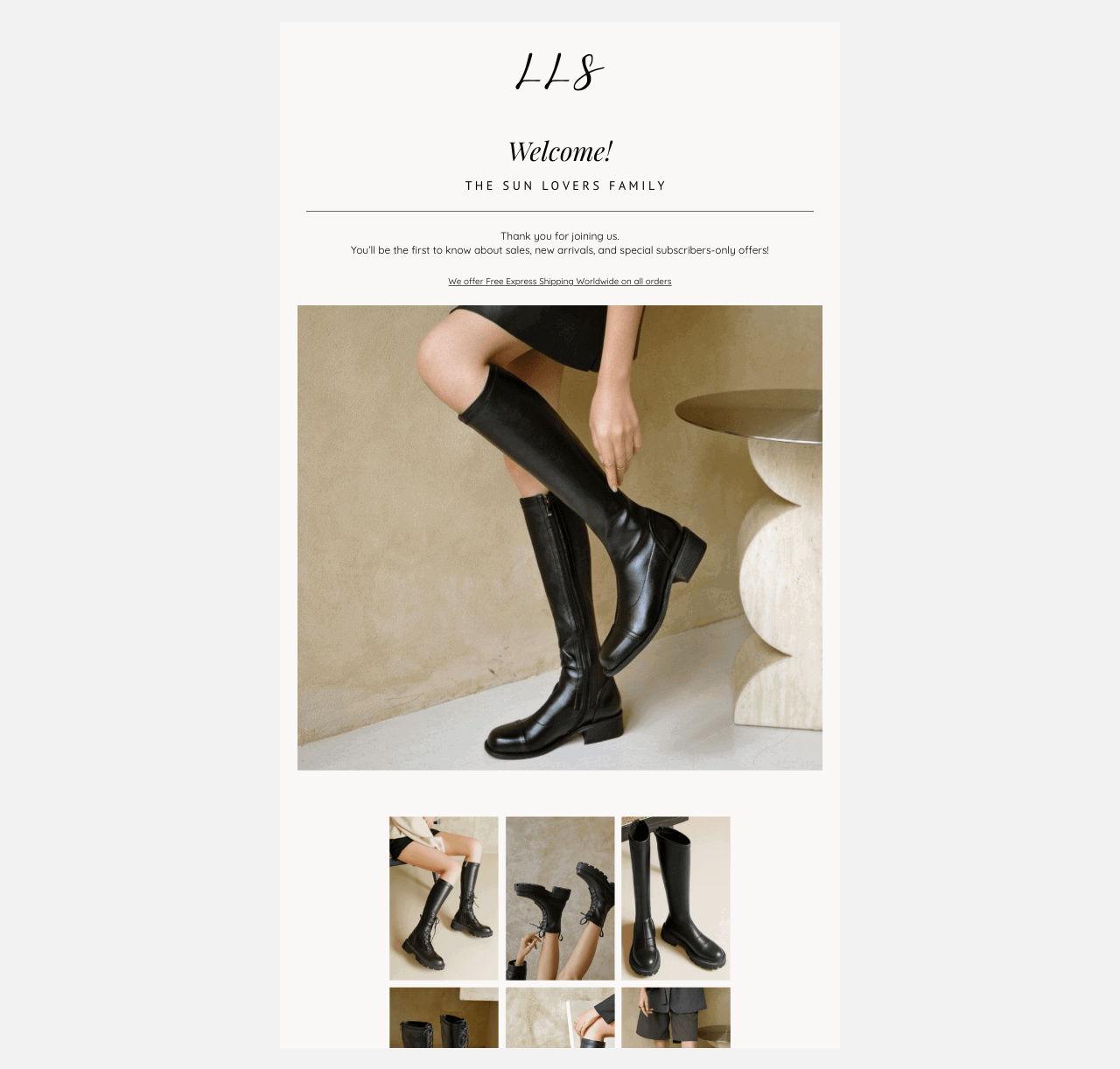
A quick welcome note like this one will work well, regardless of the incentive and the channel people use to join your newsletter. A cursive sign-off at the end costs nothing and makes a short note feel personally written. And in the case of LLS, images speak better than words.
LLS ships all orders for free worldwide, and it’s the type of information worth mentioning at the top of the email.
Instagram-grid style collage helps feature bestsellers in a natural, unobtrusive way.
The email ends with clickable blocks leading to the product categories.
Finally, if you have a loyalty program, you can thank newcomers for subscribing and invite them to start earning rewards. Aday, a sustainable multi-use clothing brand for women, makes it clear why joining the program is a great idea, and how exactly one can do that.
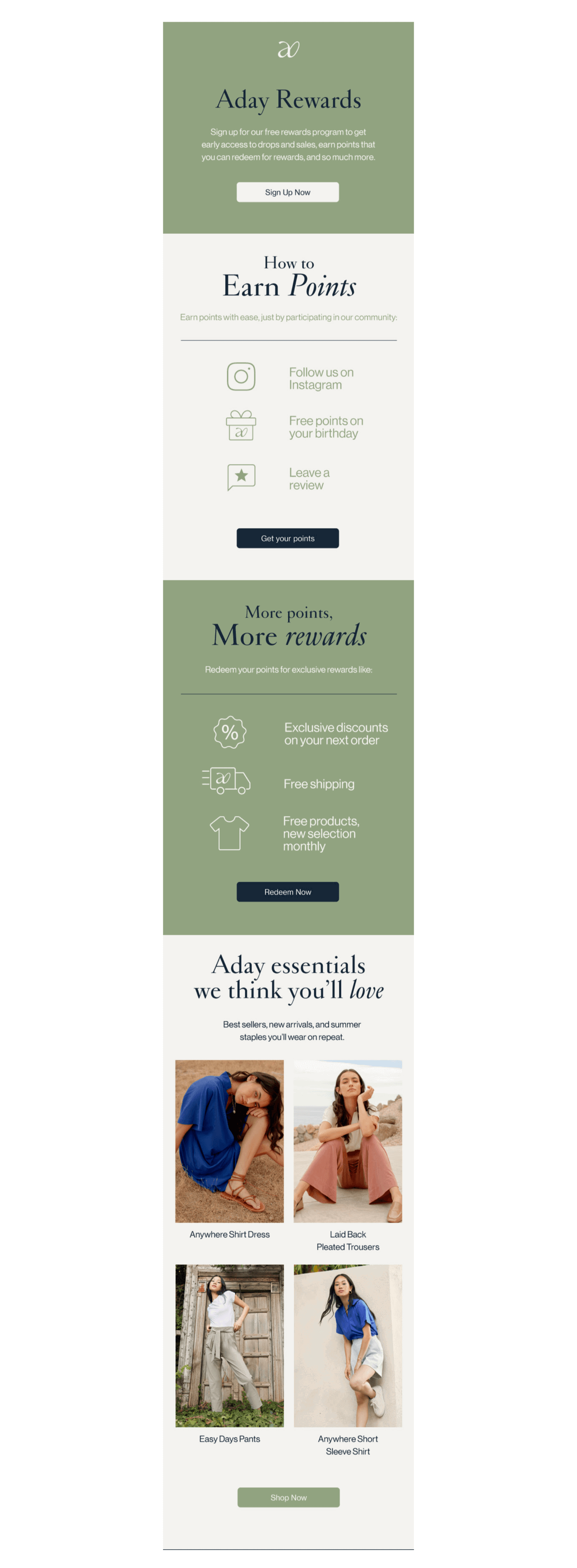
There are three CTA buttons with different texts calling for the same action.
This is an example of a great use of icons, lists, and concise copy to communicate the value and next steps.
Words are great, but nothing works better than pictures of the actual products that should incentivize you to join the program.
Here’s what surprised me most while I was doing the research for this article: out of 30 ecommerce brands I subscribed to, several never sent a welcome email at all. I hold no grudge, but it’s a lost opportunity.
When someone has just granted you access to their inbox, they’re actively expecting to hear from you. That immediate anticipation makes welcome emails uniquely powerful compared to any other message you’ll send.
According to Litmus’s State of Email 2025 report, only 42% of companies send onboarding or welcome emails. That means more than half are missing this critical first touchpoint.
Even if you haven’t crafted your perfect welcome sequence, you can always send a quick note saying “Thank you for subscribing to our newsletter. Stay tuned to hear about our new collection.” A basic message will always outperform silence. But if you want to match the performance of top ecommerce brands, you need three things: the right message, professional design, and immediate delivery.
Getsitecontrol makes welcome email automations easy. It’s a beginner-friendly email marketing platform, offering beautiful templates designed for ecommerce.
Each template is fully customizable: adjust colors, swap images, edit copy, and rearrange sections to match your brand. More importantly, Getsitecontrol lets you tag subscribers based on their interests (what they selected in your signup form) or their behavior (which links they click in your welcome email). This way, you can send more targeted email campaigns that actually convert.
The entire setup – from picking a template to launching your automated welcome series – takes less than 30 minutes. Go ahead and give it a try!
I run a small business, and the emails I send to my subscribers via Getsitecontrol have really helped it grow. I can see how the click-throughs from the emails drive purchases. The templates are super easy to use and look professional.
Mid-Century Furniture Store, UK shopifyStart by acknowledging the subscription and expressing genuine appreciation. Deliver any promised incentive (like a discount code), then set expectations about what subscribers will receive and how often. Include a clear call-to-action that brings them back to your store, like a link to your bestsellers or new arrivals.
Send your welcome email immediately after someone subscribes — ideally within minutes. New subscribers expect to hear from you right away, so delayed welcome emails lose momentum and see significantly lower engagement.
Including a discount depends on your growth strategy. Most ecommerce brands use discount incentives to grow their email lists and deliver the code in the welcome email, which drives immediate conversions. However, you can also showcase bestsellers, share your brand story, or provide valuable content instead of (or alongside) a discount.
Every welcome email should include a clear thank you message, confirmation of what they’ve subscribed to, and what happens next. Most successful emails also feature either a welcome discount, product showcase, or brand introduction, plus a prominent call-to-action button that directs subscribers back to your website.
The most effective approach is personalization. Use preference checkboxes on your signup form to tag subscribers by interest, then send different welcome emails based on what they selected. If you’re on Shopify, you can also reference products they were browsing or added to their cart before subscribing.
Nina De la Cruz is a content strategist at Getsitecontrol. She is passionate about helping small and medium ecommerce brands achieve sustainable growth through email marketing.
You’re reading Getsitecontrol blog where marketing experts share proven tactics to grow your online business. This article is a part of Email marketing section.
Try email marketing, free
Grow your list with free popups, send 2,000 emails for free.
Get started → Nov 20, 2025
—
6 min read
Nov 20, 2025
—
6 min read Mention “email popup,” and you might picture those fullscreen forms that appear too early, blocking the content you came to read.
But modern email newsletter popups are nothing like that.
Today’s popups are designed to look on-brand, feel natural within the page, and appear at the right moment — turning visitors into subscribers without being annoying.
 Aug 1, 2024
—
11 min read
Aug 1, 2024
—
11 min read The fashion industry is growing at an astounding rate. In the US alone, sales reached $358.70 billion in 2024.
If you own a fashion brand, this number is both a blessing and a curse. It’s a blessing because you’ve got some amazing potential to grow your own brand — but at the same time, your competition is trying to do the same.
Jul 3, 2026
—
4 min read An SMS popup is an on-site form that asks visitors for their phone number, usually in exchange for a discount, early access, or another exclusive perk. For brands expanding into text marketing, it’s one of the fastest ways to grow an SMS list while purchase intent is high.
Most SMS popups are simple. A visitor enters their number, agrees to receive texts, and joins your contact list for future campaigns.
Subscribe to get updates
Get beginner-friendly tips for growing your online business.